
The Power of Questions: Nurturing thinking in an inquiry classroom

What makes learning meaningful?

Is it the information students remember? Is it the answers they write in an examination in a limited amount of time? Or is it something deeper- the ability to think, question, and make sense of the world around them?

In an inquiry-based classroom, particularly within the IB Middle Years Programme (MYP), learning begins with questions of different shapes and sizes and not just a predefined set of facts to be learnt. Questions are the engine of inquiry. They stimulate curiosity, guide investigation, challenge assumptions, and ultimately help students construct conceptual understanding.

However, an important misconception about inquiry is that every question must be profound or philosophical. Effective inquiry classrooms value questions at different levels. Some questions simply help students observe. Others prompt analysis. Still others push students to form conceptual generalisations. Together, these layers of questioning support the gradual development of thinking.

Read More: A Guide to Understanding the IB (DP & MYP) Curriculum

At its heart, inquiry is about creating learning experiences where students are encouraged to wonder:

Why does this happen?

How does this work?

What might this mean beyond this situation?

These are the questions that move learning from facts to understanding. 

Educational research on concept-based inquiry suggests that inquiry learning often begins by engaging students emotionally and intellectually, activating their prior knowledge, and inviting their initial questions before deeper investigation begins. In the MYP classroom, this phase is essential because it creates the conditions for meaningful learning rather than passive reception of information. 

A simple example illustrates how questioning can spark thinking. 

Recently, our MY1 students visited Dakshina Chitra, the living heritage museum in Chennai that showcases traditional homes and cultural practices from across South India. Rather than experiencing the visit as a passive tour, students were provided with a worksheet designed around guiding questions. These prompts asked them to observe details carefully: 

  • What materials are used to build these houses?
  • Why might homes in different regions look different?
  • What similarities and differences do you notice across architectural styles? 

At first glance, these questions appear straightforward. Yet they encourage students to move beyond observation to analysis and interpretation. As students explored the houses, discussions began to emerge. Some noticed that roof structures varied across regions. Others wondered whether climate influenced building materials. Gradually, students began connecting their observations to broader ideas about environment, culture, and adaptation. 

In this way, structured questioning became the starting point for conceptual understanding, a central goal of the MYP framework. 

As students progress through the programme, the nature of questioning evolves. In earlier years, teachers often provide more structured inquiry to guide thinking. Over time, students begin to take increasing ownership of the inquiry process. 

Read More: Community Project Session for IB MYP 3 at Shiv Nadar School Faridabad 

This shift becomes particularly visible in MY3 through the Community Project. Here, students are encouraged to identify issues that matter to them within their communities. Instead of receiving predetermined research questions, students frame their own inquiries: 

  • What challenge in our community needs attention?
  • Why does this issue exist?
  • What action could help address it? 

These questions reflect a deeper level of thinking because students are defining problems, exploring perspectives, and planning action. They go beyond simply gathering information. In this process, the teacher's role shifts from delivering knowledge to facilitating inquiry. 

Similarly, in science classrooms, students often design their own investigations. A teacher might begin with a broad conceptual question such as: What factors influence plant growth? Students then refine this into testable inquiries, designing experiments, collecting data, and reflecting on results. Through this process, they develop key Approaches to Learning (ATL) skills such as research, critical thinking, and self-management, along with disciplinary knowledge. Others help them organize their thinking and identify patterns. 

Read More:  Shiv Nadar School Noida is now an IB MYP Authorised School 

What becomes evident across these experiences is that questions guide every stage of learning. Some questions help students engage with a topic. Some help them investigate evidence.Eventually, students begin forming generalisations- statements of understanding that connect concepts and can be applied beyond a single example. When students reach this stage, they are developing ideas that can transfer to new contexts, which is beyond the recall of information without a context. 

This is one of the most powerful goals of the IB philosophy: helping learners build knowledge that is transferable and meaningful. This also helps in furthering our commitment to lifelong learning at Shiv Nadar School

Yet perhaps the most significant shift in an inquiry classroom occurs when students themselves become the questioners. Instead of waiting for the teacher’s prompts, they begin to ask: 

  • Is this always true?
  • What evidence supports this idea?
  • Could there be another explanation? 

These moments signal something important. They show that students are developing agency as learners, instead of merely participating in lessons as passive listeners. This is the goal of our MYP classrooms. 

In the end, the success of an inquiry classroom may not be measured by how many answers students produce, but by the quality of the questions they learn to ask to pursue meaningful journeys responding to those questions. When classrooms nurture curiosity, encourage reflection, and value thoughtful questioning, they cultivate learners who are prepared for the complexities of the world beyond school, beyond any single examination. 

Perhaps, then, the most important question we can ask ourselves as educators and caregivers is this: 

Are we creating spaces in the classrooms and outside where curiosity thrives? Are we modelling the thinking process that we want our children to embody? 

Because when students learn to ask meaningful questions, they begin to see learning as a journey of discovery of their own selves and the world around them.  

2026-03-19
Where Learning Takes Shape: The Role of Makerspaces in Schools

Walk into a classroom today, and you can sense a quiet change. Learning no longer lies in a single correct answer on the board. Students are taking things apart, putting ideas together, and discovering that real understanding often grows through doing.

This is where makerspaces come in.

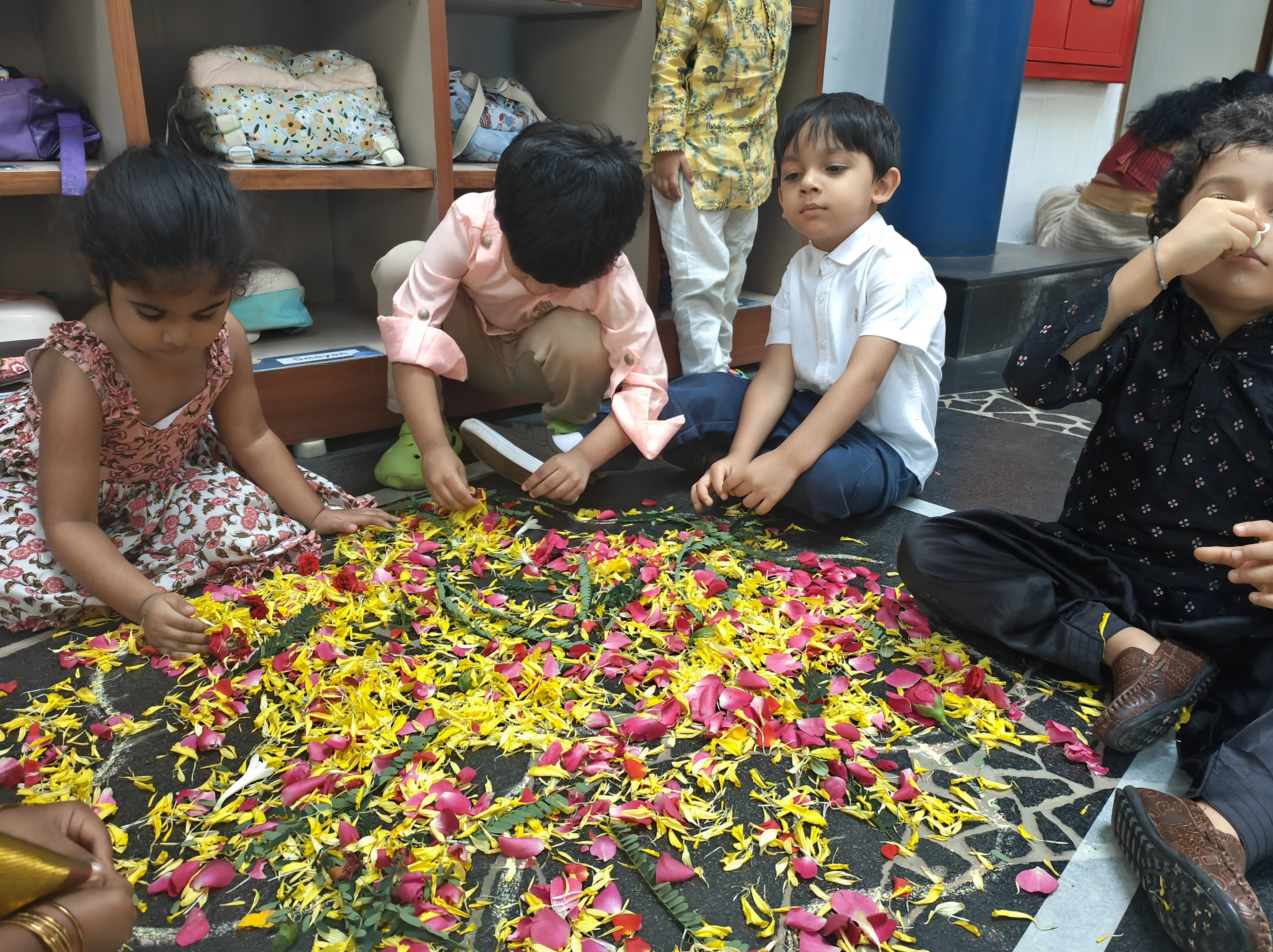
A makerspace is a room where students feel free to try things out. They experiment, make mistakes, laugh about them, and try again. Curiosity shows up in half-built models, scattered tools, and conversations that continue long after the bell rings. It is a place where ideas slowly turn into things you can see, test, and improve.

What is a Makerspace?

A makerspace is a shared learning space built around making and experimenting rather than passive listening. It supports creativity, resilience, problem-solving, collaboration, and real-world application, all of which students need in an ever-evolving world.

Inside, you might see:

  • Digital fabrication tools: 3D printers, Laser cutters, Metal lathes, Wood lathes
  • Electronics & robotics: Arduino, Raspberry Pi, micro:bit, sensors
  • Woodworking & metalworking tools and Machines
  • Crafting and prototyping materials
  • Collaborative zones for brainstorming, design thinking, and project documentation


It is essentially a space where ideas meet tools and creativity finds expression.

Here, students feel comfortable saying, “Let me see what happens if I try this.” Mistakes feel normal. Reflection becomes part of the rhythm of the work.

Why makerspaces matter in schools

Makerspaces shape the way students experience learning. They gently move learning from knowing into creating.

They encourage creativity and problem-solving.
Students meet obstacles and learn to work through them. Problems begin to feel like puzzles to explore rather than barriers.

They make STEM and STEAM concepts real.
A bridge that falls apart explains balance. A stubborn program explains logic. Understanding grows through experience.

They build collaboration in a natural way.
Students plan together, combine ideas, and create something shared.

They allow different learning speeds.
Some students jump straight into building. Others watch quietly, think, and then begin. Both approaches feel welcome.

What a makerspace contains is important. The culture inside it matters even more.

Tools help. Culture transforms.

An impactful makerspace grows from:

  • a clear learning purpose connected to the curriculum
  • design thinking habits
  • safe and easy access to tools
  • teachers who feel confident guiding open-ended work
  • student clubs, maker fairs, and community challenges
  • links with project-based learning, sustainability, and real-world problem-solving

Students begin to teach themselves, explore on their own, and take ownership of ideas. The makerspace becomes part of the school’s way of learning.

How makerspaces change the learning experience

When students see an idea turn into something they can touch, learning feels different.

Projects start to feel personal. Work becomes something they care about, not just a task to finish. Motivation comes from pride and curiosity.

Different kinds of learners find their space too. The builder, the observer, the dreamer, the coder, the artist. Each one belongs.

A connection to the real world

What happens in a makerspace feels similar to what happens in design studios and labs outside school.

Students test ideas, build prototypes, talk through what went wrong, and try again. There is space for more than one answer. Over time, they become comfortable with uncertainty and open-ended work.

What happens inside a school makerspace?

On any regular day, you might see:

  • a robot that takes an unexpected turn
  • a 3D-printed piece that works on the second or third attempt
  • students redesigning something because the first version did not work
  • towers and bridges being tested for strength

There is focus, laughter, and the familiar sentence, “Wait, I think I know what to try next.”

The long-term impact on students

With time, makerspaces change the way students see themselves.

They become more willing to stay with difficult problems.
They learn that confusion is temporary.
They begin trusting their own ideas and instincts.

Better academic understanding follows, but something deeper grows beneath it: confidence, patience, empathy, and curiosity.

Why makerspaces matter today

Makerspaces recognise how children naturally learn. They explore, build, imagine, get messy, and try again. They connect science, design, engineering, arts, and technology in ways that feel real and meaningful.

At Shiv Nadar School, Chennai, the makerspace is often full of students who hope for a few extra minutes. They return to unfinished projects, celebrate small breakthroughs, and sometimes take everything apart to begin again. The space reminds us what learning feels like when it is alive, joyful, and genuinely hands-on.

2026-01-23

Design Thinking in Schools: A Blueprint for Future Innovators

Children are natural problem-solvers. Give them a puzzle, a loose screw, or a situation that feels slightly confusing, and they instinctively start exploring possibilities. This instinct of theirs needs to be recognised as a strength. Learning is no longer seen as simply arriving at the right answer; it is also about how students approach a question, what they observe, and how they respond when things don’t work the first time.

Design thinking sits beautifully in this space.

It offers a simple, repeatable way to understand a problem, think through options, and try ideas in real contexts. Instead of rushing to solutions, students pause, observe, and listen. They learn to understand who they are designing for, what truly matters in a situation, and how ideas evolve when tested in the real world.

Over time, this way of thinking builds confidence. Students begin to realise that uncertainty is not a barrier; it is a starting point.

What is Design Thinking in Schools

Design thinking is a process of working through problems thoughtfully and creatively.

In classrooms, it looks like students:

  • observing a situation closely
  • listening to people involved
  • framing the core problem clearly
  • suggesting many ideas instead of one
  • building simple prototypes
  • testing and refining their work

It builds habits of curiosity, reflection, and iteration. Students learn to balance imagination with practicality, using skills to act on the needs and ideas they uncover.

The Five Stages of Design Thinking

Design thinking unfolds through five connected stages. Each stage invites students to think a little deeper and notice a little more.

1. Empathise

Students begin by understanding people and contexts. They talk, listen, observe, and ask questions. They try to see situations from another perspective. This creates a sense of purpose that guides everything that follows.

2. Define

From all the observations, students identify what actually needs attention. They clarify the challenge rather than tackling everything at once. A well-defined problem gives direction and meaning to the work ahead.

3. Ideate

With a clear purpose in mind, students explore ideas openly. They think widely, allowing imagination to respond to what they have seen and heard.

4. Prototype

Ideas take visible shape. A sketch, a model, a storyboard, or a simple mock-up helps turn intention into action. Skills begin to grow naturally as students try to make their ideas work in the real world.

5. Test

Students try out what they have created. They notice what works, what doesn’t, and why. Feedback becomes part of learning, helping them refine both their thinking and their approach.

Through this cycle, students begin to see that improvement is a natural outcome of responding thoughtfully to real needs

Why Teach Design Thinking in Schools?

It begins with purpose and empathy
Students learn to notice people, situations, and challenges around them. This sense of purpose gives meaning to what they create and guides the choices they make along the way.

It strengthens thinking through action
As students work toward addressing real needs, they assess information, weigh options, and make thoughtful decisions. Skills grow as part of trying to make an idea useful, not as an end in themselves.

It supports communication and collaboration
Most design-thinking tasks involve teams. Students explain ideas, listen closely, and work through differences. They experience what it means to build something together for a shared purpose.

It nurtures holistic learning
Design thinking connects science, art, technology, humanities, and everyday life. Learning feels linked by meaning rather than divided by subjects.

How Design Thinking Shapes Future Innovators

Students who practise design thinking begin to:

  • stay attentive to the needs around them
  • adapt when situations change
  • treat mistakes as part of understanding
  • remain curious for longer
  • approach challenges with calm

These habits form the foundation of innovation. They prepare students to step into changing careers, unfamiliar roles, and new technologies with both skill and intention.

What Design Thinking Looks Like in Classrooms

Design thinking in schools doesn’t always have to appear through large projects. Often, it shows up in small, thoughtful moments:

  • redesigning everyday objects to make them easier to use
  • rethinking shared community spaces
  • creating simple prototypes for sustainable products
  • building and testing robots to solve practical problems
  • working on social impact projects in the school or neighbourhood
  • designing posters, apps, or interfaces to meet real needs

The focus remains on moving from understanding to action, shaped by reflection along the way.

A Way of Thinking That Stays With Students

Design thinking helps students become calm, flexible thinkers who are willing to try, reflect, and try again. It nurtures empathy alongside creativity, judgement alongside imagination. It helps students see themselves as capable of shaping the world around them, thoughtfully and responsibly.

At Shiv Nadar School, it finds a natural place in everyday learning, shaping the way students approach questions, ideas, and the world they are growing into. Here, design thinking is a way of learning, not a one-time activity. It shapes how students question, empathise, experiment, and respond to real-world challenges. By valuing process over quick answers, the school nurtures confident problem-solvers who are comfortable with uncertainty and capable of thoughtful action. Embedded in everyday learning, design thinking prepares students to shape the future with purpose and responsibility as truly holistic learners who embody our values and vision.

2026-01-23

The first edition of SparkEd, our digital-first magazine, is here!

We are proud to announce the inaugural edition of SparkEd, Shiv Nadar School’s annual digital-first magazine. A space where ideas evolve and shape the way you see the world. Each story, insight, and perspective shared in this magazine has the potential to kindle greater awareness, be a moment of reflection, and inspire meaningful action.  

The Theme: Sustainability and Climate Change 

Today’s learners are growing up in a world where climate change is part of everyday life. They experience it through rising temperatures, extreme weather, and changes in nature. The first edition focuses on Sustainability and Climate Change, an urgent and deeply personal issue that touches every aspect of our lives.  

In this magazine, you’ll find diverse voices of students, educators, parents and thought leaders, reflecting on lived experiences and unpacking global challenges. We have highlighted key social impact initiatives, showcasing our sustainability, technology, and innovation stories. The magazine celebrates the achievements of our students and faculty, reinforcing the ethos of Shiv Nadar School. 

We hope that this magazine helps you discover:  

  • How small everyday actions can contribute to environmental change.
  • The role of design and architecture in creating sustainable spaces.
  • Student-led projects that bring sustainability to life in practical ways.
  • Perspectives on how technology and creativity can help address climate challenges. 

A Platform for Thought Leadership 

In the future, each edition of SparkEd will continue to explore themes that are globally relevant and engage with pressing issues of our time, aiming to spark thought-provoking conversations. 

SparkEd is a platform where dialogue, curiosity, and collective imagination come together. We invite you to read, reflect, and join us in nurturing a culture where every spark can ignite change. 

2025-12-24

The Unscripted Curriculum

Article authored by: Chinar Banga

Head Senior Years, Shiv Nadar School Faridabad


Schools are synonymous to learning. Books, curriculum, assessments, lesson plans, report cards will automatically cloud your thoughts when you think of school. We often assume that the scripted curriculum of the school or what the board prescribes will lead to students’ progress. In middle and high school particularly, you will notice a sudden shift in parent and teacher mindset where they would only want to work towards a target score. However, what we often forget is a powerful force that often shapes student behaviour, beliefs, attitude and values. It is the unscripted curriculum that has a significant role in their development. It has, in fact, more impact than calculus, history, force or other concepts they learn in school. What defines this unscripted curriculum, is how the adults around these students conduct themselves in the school environment. Philip Jackson in his book, ‘Life in Classrooms’ referred to conscious and unconscious norms, values and behaviours of the learning process, including unplanned and unintended learning outcomes that influence students. It is not necessary that only the teachers are being noticed. 

The leaders, administrative staff and even the support staff behavior also doesn’t escape their watchful eyes. They internalise lessons from every interaction they witness in corridors, cafeterias, assembly halls and other spaces. Albert Bandura, in his Social Learning Theory, emphasizes the importance of observing, modeling and imitating the behaviors, attitudes and emotional reactions of others. This becomes even more profound in higher grades. Adolescents in middle and senior school have heightened social awareness and are in their identity formation phase. As a result, what they see around them becomes a reference point on how they will react to different situations and relate to the world around them. A high school student who is testing boundaries and is moving away from authority will have a sharp antenna for detecting hypocrisy. If what is being preached, is not modelled, they will rebel. For example, a school poster or policy may display the value of kindness, however, if the teacher behaviour is otherwise, the trust of the child in the system shakes. When students see teachers conducting themselves with professionalism and mutual respect, they will mirror it. When they see that the school culture is of celebrating each others’ success, respecting support staff, leaders taking and valuing feedback and agency, the ripple effect will be visible. 

On the contrary, gossip, envy, passive aggressive behavior will lead to more effort on teachers’ part in setting classroom expectations and managing the behavior for learning. It is therefore, every adult’s responsibility, to model behaviors that they would want their students to imbibe. School culture is driven by the choices the adults make when no one is watching. But the irony is that students are always watching! When students see people around them owning up mistakes, apologising to a fellow colleague, greeting support staff cordially, appreciating diverse perspectives, working in teams, they will organically develop the values of accountability, teamwork, respect and compassion. Since the interactions are not limited to the physical space and extend to the virtual world as well, teachers need to display explicitly respectful online interactions to expect the same from their students in the digital world. The good thing is that evolving this unscripted curriculum is not something impossible. Every school needs to have a systemic approach to develop these values and soft skills over a period of time. 

Schools that recognise the value of this unscripted curriculum will equip their children with an ethical compass that will guide them home. Teacher professional development sessions, admin and support staff briefing sessions, leadership workshops should have a special mention of the acceptable behaviours around students. Investment in socio-emotional learning of school teachers sees its students developing maturity and empathy. It is also very important to note that the way we assign consequences to the students is also something to look at. Punitive actions may lead the students to believe that mistakes are shameful. However, a consequence rooted in responsibility and reform will make a difference. When students walk out of school, they will carry with them the lessons of the curriculum which are delivered by gestures, daily choices, routines and rapport of the adults around them in school. The students’ skills to adapt and thrive in a new college environment, being resilient to challenges in a workplace or their conduct in a social gathering will be a reflection of what the have seen through their formative years. 

As adults around children, we need to be conscious of what we bring to table everyday and the example we are setting for them. To develop ethical, happy and purposeful citizens of the society, the adults around them need to be emotionally intelligent and reflective in nature. Let’s not forget that the students are learning the scripted and the unscripted curriculum everyday!

2025-12-09

Listening to the Hundred Languages of Children

At Shiv Nadar School, our Early Years classrooms are places of wonder — where play based learning is not just an activity but a way of thinking, exploring, and expressing. We believe that every child speaks in a hundred different ways: through movement, art, storytelling, laughter, and curiosity. Our approach to play based learning in early childhood ensures that children discover, question, and create through meaningful, joyful engagement. 

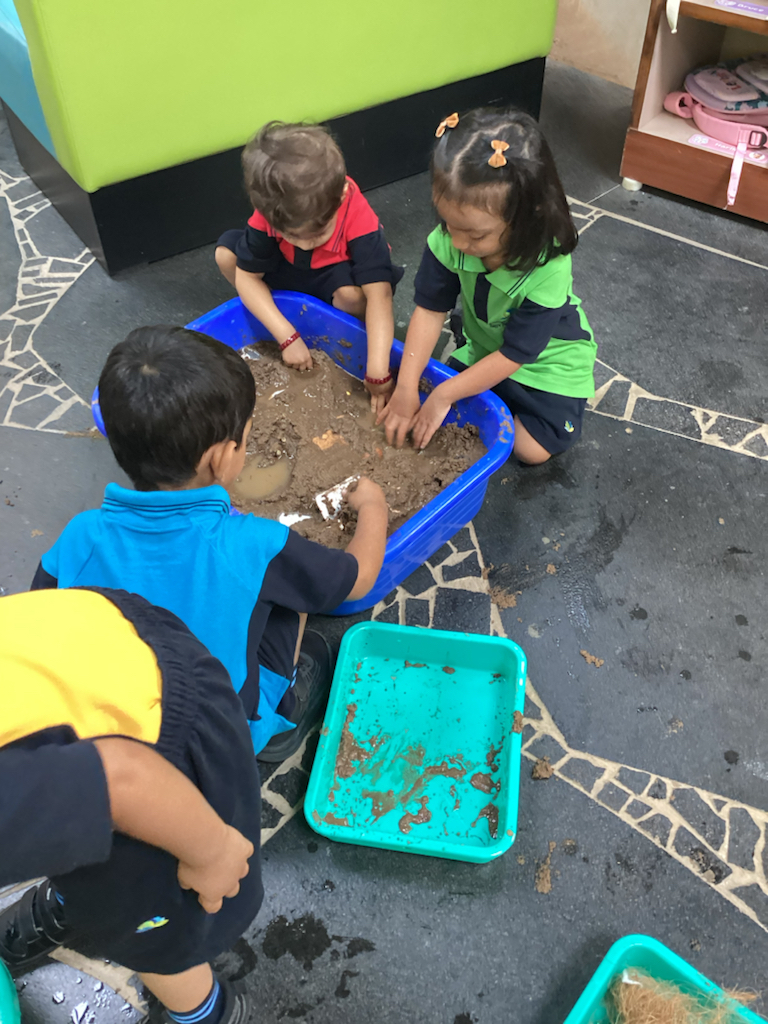
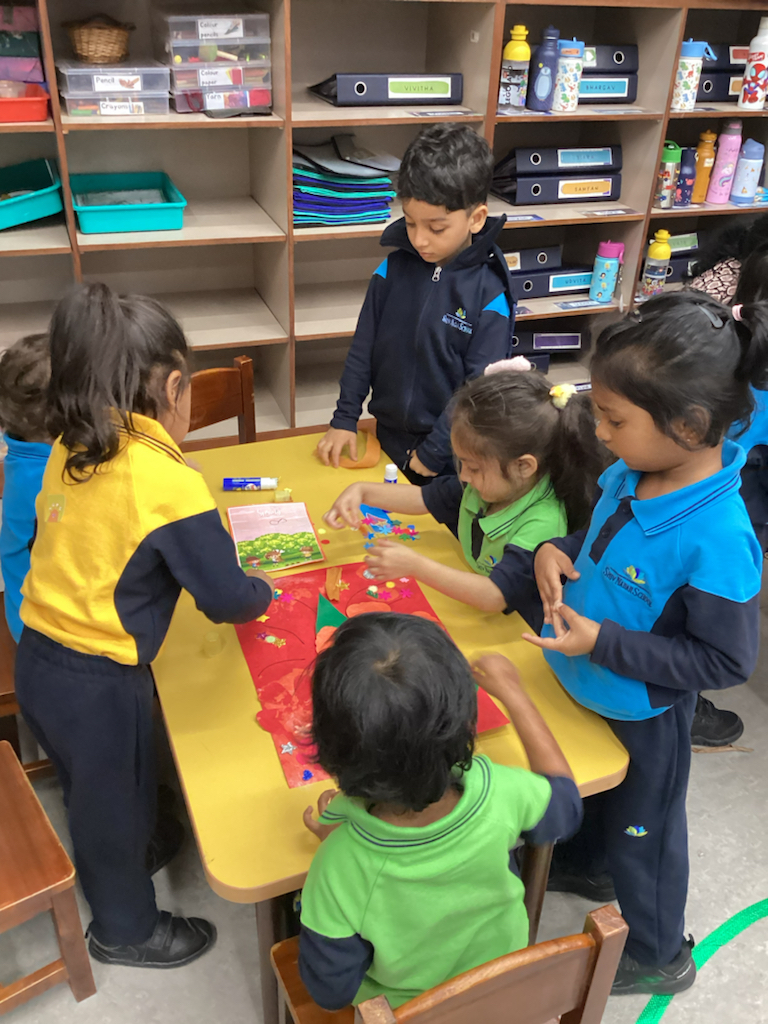
In our learning spaces, children are encouraged to express what they know and feel through hands-on play based learning activities. Every block tower, every song, every brushstroke tells a story of discovery and growth. 

Exploration and Wonder

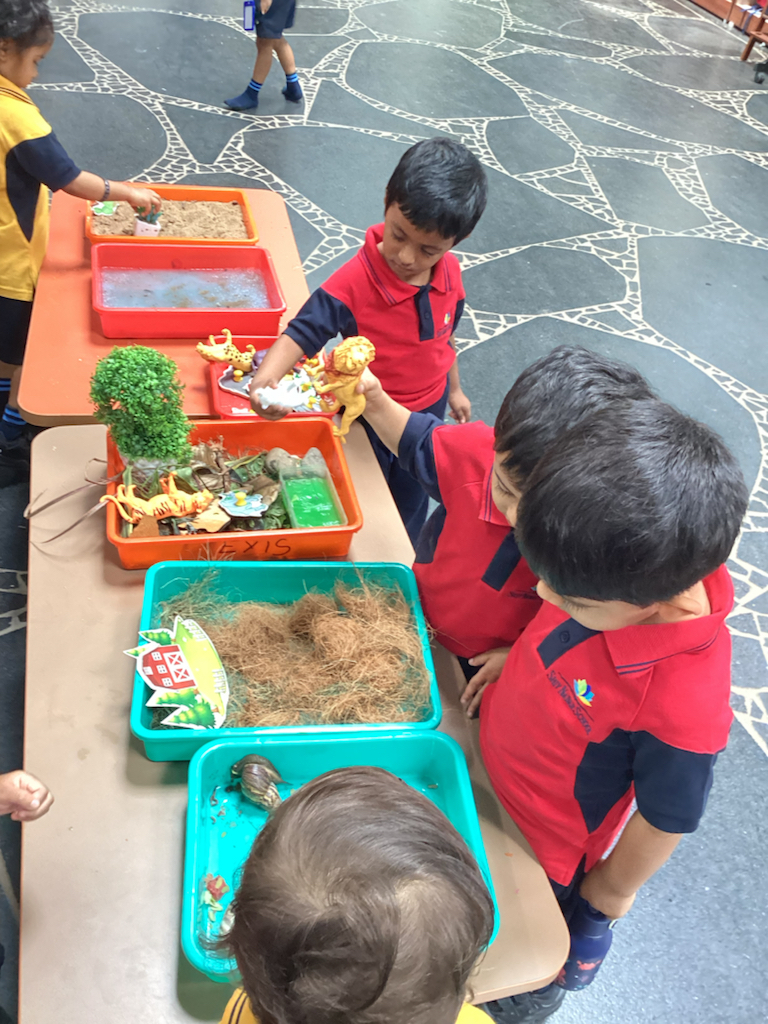
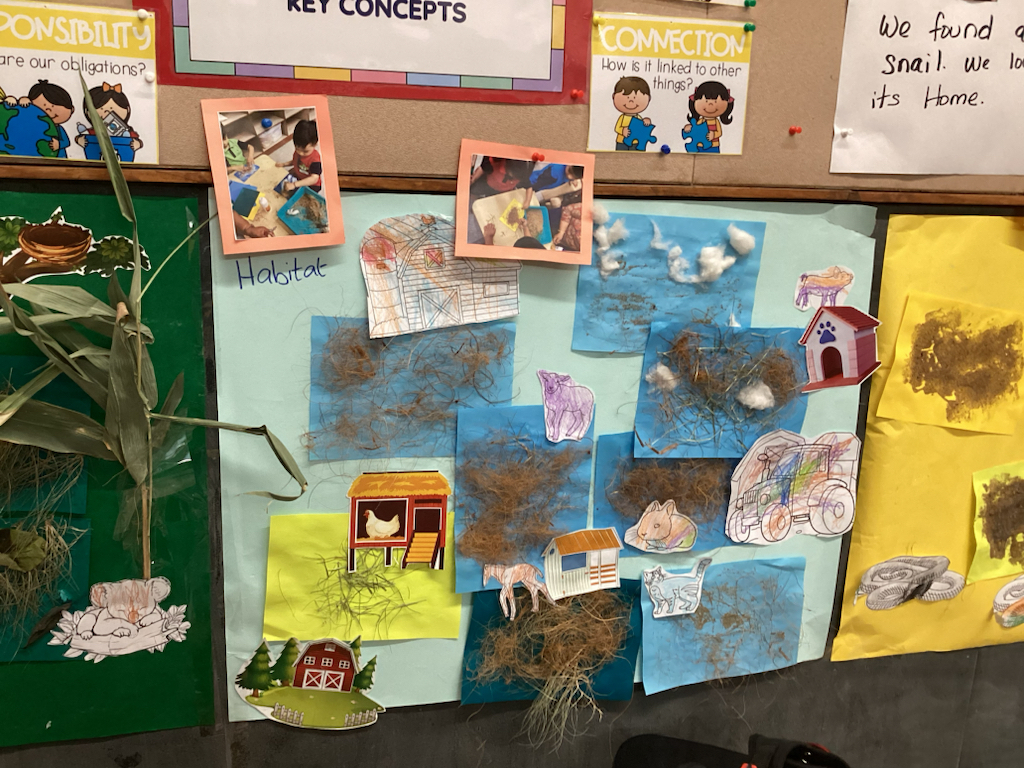
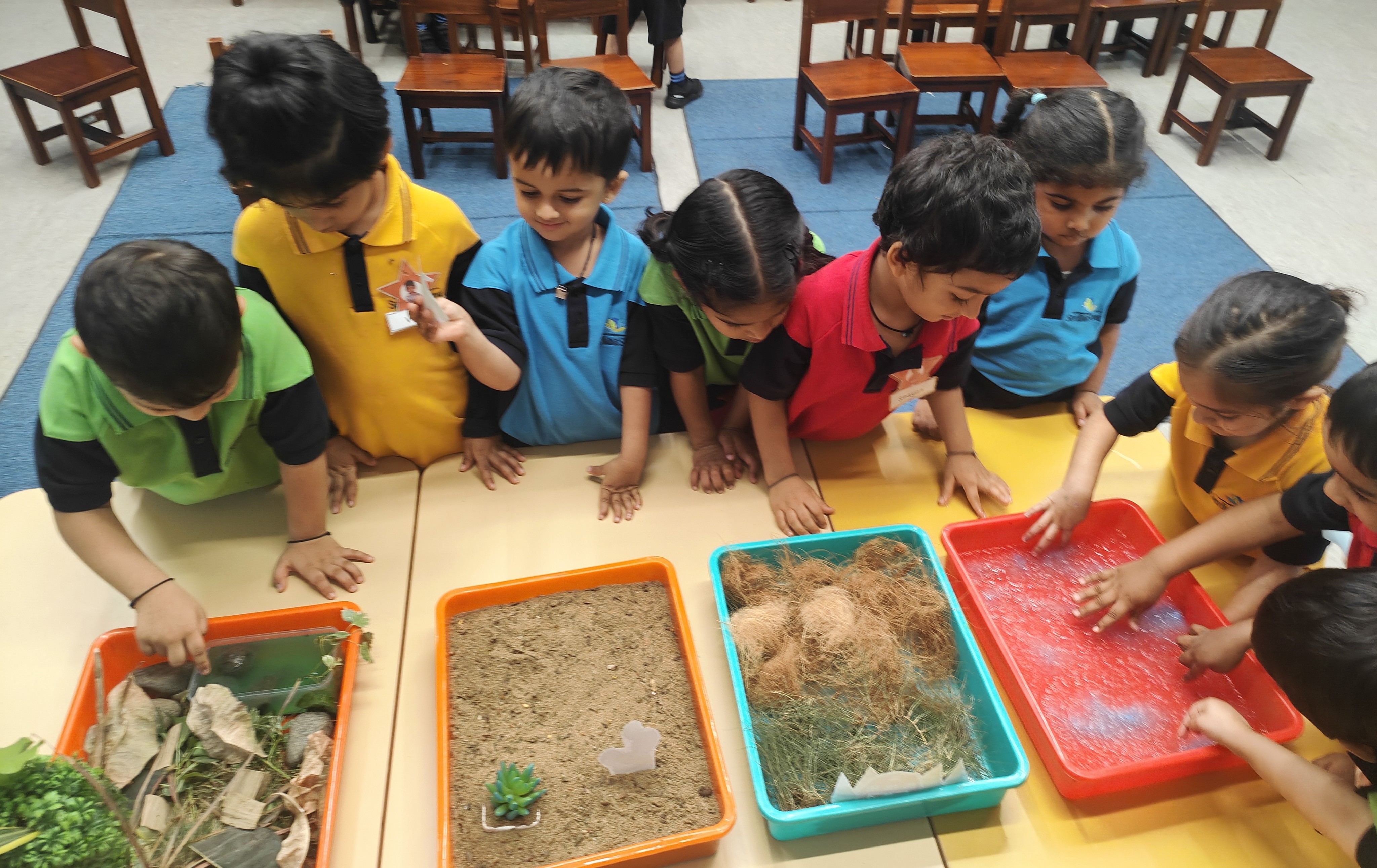
Our learners are natural explorers. They use their senses and imagination to make sense of the world  around them. During our recent inquiry into Living Things and Celebrations, classrooms came alive with small-world setups — jungles, oceans, and deserts filled with creatures and stories. 

“Look, the polar bear needs snow!” a child explained, carefully placing cotton near a model animal. In that moment of learning through play in early childhood education, science and storytelling came together beautifully. 

Learners also explored festivals through art and music. Bright colors, joyful patterns, and rhythmic beats filled our spaces. “I’m painting fireworks because they make people happy,” said another child, showing how emotion and creativity are deeply linked. 

For teachers, every playful moment became a window into children’s thinking. Through observation and gentle questions — “What makes this animal special?” or “How does your celebration sound?” — we guided learners to deepen their curiosity and understanding. These interactions highlight how early years learning through play forms the foundation for inquiry and imagination. 

Collaboration and Expression

As learners grow, their play naturally becomes more social and expressive. In our Early Years classrooms, collaboration is at the heart of play based learning. 

During our unit on Communities and Family, learners designed homes and community spaces using blocks and loose parts. “We need a roof so it doesn’t rain inside,” one suggested. Together, they planned, built, and reflected — developing problem-solving and teamwork skills in the process. 

Dramatic play areas buzzed with activity. Through role play, learners explored empathy, responsibility, and belonging — core benefits of play based learning in early childhood. 

Art also became a shared language. Family portraits, drawings of plants, and collaborative murals reflected how children see growth, change, and connection. These experiences show how playing and learning through play in early childhood education support communication, confidence, and care — key qualities that define our philosophy. 

Reflection and Representation

In EY3, reflection becomes a natural extension of play. Children revisit their experiences, look at photos, drawings, and portfolios, and talk about what they’ve learned. 

“I remember when we planted this seed — now it’s growing!” a child shared during a reflection circle. Revisiting moments like these helps children see their own growth — both in skill and in self-awareness. 

Storytelling and journaling are other powerful tools for reflection. When children narrate how they cared for plants or helped a friend, they express empathy and understanding. “I water my plant every day because it gets thirsty like me,” one child said — a small but profound connection between care and compassion. 

Quiet moments of observation also play an important role. Watching shadows move or sketching leaves nurtures mindfulness, patience, and wonder, reinforcing the reflective side of early years learning through play. 

The Many Languages of Learning

Across our Early Years classrooms, we see the harmony of many languages — exploration through play, expression through collaboration, and reflection through representation. 

Every playful interaction reveals deep thinking. Every creation, conversation, and story tells us how children see their world. 

At Shiv Nadar School, play based learning is the foundation of learning. It is through learning through play in early childhood education that children inquire, imagine, and build meaningful connections. When we listen closely — not only with our ears but with our hearts — we discover that children are not just learning about the world; they are teaching us how to see it. 

“When we listen with wonder, we realize that every moment of play is a moment of learning.”

2025-11-26

Shiv Nadar School MUN: From Classroom Debates to Global Forums

At Shiv Nadar School, debate is not confined to classroom walls. For our students, raising a hand in class is just the first step toward raising their voices on the global stage. MUN at Shiv Nadar School embodies this spirit. In this year’s conferences, students stepped into the shoes of diplomats, journalists, and policymakers, and discovered how their words could shape the world. Read along for glimpses into the two days; moments of collaboration, negotiation, and reflection that show what student voice looks like in action.

Morning: A Seat at the Table

The day begins with students filing into the conference hall, placards in hand, countries assigned. Some glance at their opening notes for the tenth time. Others trade nervous smiles. A Grade 9 student who once hesitated to speak up in English class now sits as the delegate of India in the United Nations Office on Drugs and Crime (UNODC), preparing to raise concerns about cross-border drug trafficking. As the student newsletter reported, the Indian delegate “called for greater international intelligence cooperation, with the looming threat of a strengthening link between drugs and terrorism”.

Another student, representing a country, pores over briefing papers on anti-corruption reforms. The session is about narcoterrorism, a subject that pushes teenagers to think about how crime, politics, and global security intersect. Delegates quickly realise that their voices matter. Not because they can recite a polished speech, but because they are expected to take a stand, however imperfect.

And yet, the room is not uniformly confident. Some students speak assertively, but many remain tentative. Chairs keep the momentum alive. “The chair’s help is undoubtedly tethering this committee, with their constant encouragement of those who seem hesitant to speak up,” noted one journalist. A quiet delegate finally raises a point of information; voice unsteady but resolute. It may not make headlines, but in that moment, the step itself is the victory.

Midday: Learning to Listen

As debates heat up, it becomes clear that effective leadership is not about speaking the loudest. In UNEP sessions on climate-smart agriculture, delegates from Chad and Bangladesh share stories of small farmers facing food insecurity. One observer recorded, “It is the countries with comparatively lower incomes who talk about how they are managing taxes and trying to employ technology to advance their economy”.

For many students, this is the first time they have encountered how inequality shapes international conversations. The debate turns when a delegate from Bangladesh shares a story about rural farmers losing entire harvests to unpredictable floods. A hush settles over the hall. The lesson is not lost: listening to data, to perspectives, to lived experiences, is just as powerful as speaking.

Some delegates dominate the floor, while others take a moment to gather their thoughts. With each prompt from the dais, more hands rise, and new voices join the conversation. One student later reflected that every contribution, no matter how tentative at first, was part of the learning, a reminder that confidence and conviction grow with practice.

Afternoon: Writing the World

By the afternoon, resolution writing takes over. Laptops glow across the room as blocs gather, words flying faster than fingers can type. Here, the energy shifts. Students who were quiet in debate find their rhythm in negotiation.

A Grade 10 delegate reflects: “Every word counts when you’re drafting resolutions.” It is not an exaggeration. For twenty minutes, two countries lock horns over a single verb: should the resolution “urge” or “demand”? The students realised that international peace depends not on “grand speeches” but on “cooperation, openness, and technology-enabled enforcement”. One student laughs that they “forgot which country I am today,” a moment that brings smiles across the room and reminds everyone that even in intense debate, learning can be fun.” Resolution writing becomes equal parts frustration and discovery. Students learn that compromise is less about winning points than about staying at the table long enough to shape the outcome.

Evening: From Debate to Reflection

As sessions wind down, the International Press Corps rushes to file stories. Their work is not just documentation. It is a critique. One report described “the fiery exchanges, the breakthroughs, the silences that said as much as words”. Another noted how ambition was transforming into action, recognising that delegates were finding ways to bring their ideas to life with growing confidence.

For the first-time delegates, it can feel uncomfortable to see their work dissected. Yet this is where another dimension of voice emerges. It is the power to write, to analyse, to hold peers accountable. The press corner, tucked away at the back of the hall, becomes a reminder that every word has an audience, and every debate, however simulated, is also a performance.

Beyond the Conference: Habits of Voice

Back in their classrooms, the skills acquired at MUN do not vanish with the placards. Students carry them into interdisciplinary projects and personal reflections. A student working on media bias realises she is asking the same questions she asked as a journalist at MUN: Who benefits from this narrative? Who is left out?

Others take with them the dilemmas and discussions they navigated in committees. Those debates may have ended with draft resolutions, but the questions they raise linger in the lunchroom, in project work, in the corridors.

Whether analysing political cartoons in Individuals and Societies or planning a model island in Geography and Math, students practise the same habits that make them effective MUN delegates: inquiry, reflection, and the courage to speak.

Why It Matters

MUN is about cultivating a lifelong habit of voice. The newsletters themselves, written by students for students, show that voice is not always triumphant. It can be critical, hesitant, or even contradictory. But it is present.

One student journalist wrote: “MUN is where ideas meet action.” Another warned that diplomacy without passion risks becoming performance. Between these lines lies the heart of the experience. Voice is not given. It is practised.

From classroom discussions to international forums, our students learn that democracy, diplomacy, and even day-to-day collaboration depend on respectful yet assertive dialogue. The MUN may last two days, but the skills, confidence, and perspectives students gain continue to shape how they engage with the world.

2025-11-06

From Experts to Co-Learners: How Parents Can Grow with Their Children

“What do I say when my child asks me a question I can’t answer?” A Shiv Nadar School parent shared this during a coffee meet. Her child had come home after a school unit on climate change, filled with questions she hadn’t anticipated. “I tried to look things up,” she said. “But I realised I was more anxious than helpful. I didn’t know what I was supposed to say.” It was an honest admission, and one that rang true for all of us.

Over the past decade, the world has become increasingly interconnected, unpredictable, and complex. Technology is evolving faster than it can be regulated. Climate change is no longer a distant concern. Global workforces are shifting. AI is rewriting how knowledge is created, stored and accessed.

But while the world has changed, the way many of us were raised, and the instincts we rely on as parents, remain largely the same. We focus on performance and look for certainty. We lean on familiar milestones, which is understandable, but not always helpful.

At Shiv Nadar School, future-readiness is built into the way students learn. Since no student learns in isolation, the school works closely with families. The goal is to help parents move from outcome-driven expectations to growth-oriented understanding.

As one educator put it, we’re not just preparing children for jobs. We’re preparing them to solve problems that don’t exist yet.

Why the Old Model Falls Short

For many years, the assumption was simple: if children performed well in school, they would succeed in life. This created a clear path. Study hard, secure good marks, and choose a stable career. That model was designed for a predictable world. Today’s reality is different.

Students growing up now may need to switch careers multiple times. They will make decisions without complete information and collaborate with people across cultures, time zones and disciplines. For this, just subject knowledge is not sufficient.

At Shiv Nadar School, the goal is to move beyond rote learning and foster critical thinking, creativity, and effective communication, skills that are vital for success in the 21st century. The International Baccalaureate (IB) program helps build these capacities. Students are not taught what to think. They are supported in learning how to think.

This shift is visible in everyday classroom practice. In the Primary Years Programme (PYP), children inquire into real-world themes such as identity, fairness or responsibility. These are not abstract discussions. They are grounded in local context, classroom experiences and personal stories.

In the Middle Years Programme (MYP), students draw connections across subjects. A science lesson may link to social justice. A design project may respond to a community need. Students are encouraged to think across disciplines.

In the Diploma Programme (DP), elements such as the Extended Essay, CAS (Creativity, Activity, Service), and Theory of Knowledge (TOK) give students space to investigate, reflect and act. These are not add-ons. They are part of how students grow.

The Shift in Parenting

Parents often feel they need to have the answers. However, in a world where the questions themselves keep changing, the role of the parent is shifting. Children do not need experts at home; they need co-learners.

Co-learning is a mindset. It means staying open to new ideas, even when they challenge your own. It means asking questions together and showing your child that learning continues beyond school. As one teacher explained, you don’t need to know all the answers but just need to keep asking good questions.

This supports academic growth and creates emotional safety. Children feel more comfortable sharing uncertainty, making mistakes and exploring different perspectives.

One parent put it simply: when I stopped asking, “What marks did you get?” and started asking, “What made you curious today?”, our conversations changed completely. Children are more likely to open up when they do not feel evaluated. Curiosity invites dialogue. Over time, that builds trust.

Small Shifts That Matter

This shift does not require new tools. It requires a change in what we choose to notice. If you would like to try this at home, here are three small ways to begin:

  • Instead of asking what your child learned, try: “What are you still wondering about?”
  • Share one thing you learned this week from a book, article or conversation.
  • When your child asks a difficult question, say: “Let’s figure it out together.”

These signals matter. They tell children it is normal not to know something and valuable to keep learning.

What Shiv Nadar School Makes Possible

At our school, families are participants in the learning process. Parent workshops, classroom showcases, community events and reflection sessions are designed with this in mind. These are shared spaces where parents can listen, observe and think alongside their children.

In classrooms, curiosity and care are part of the curriculum. In the school's culture, they are an integral part of every interaction. IB frameworks provide structured opportunities for students to reflect, take initiative and engage with real-world ideas. Shiv Nadar School ensures that families have space to participate in this journey. This includes more than just report cards or events. It includes everyday moments of learning and connection.

It is normal to feel unsure. Parenting in a changing world can feel overwhelming. But you are not required to stay ahead of your child. You just need to stay with them.

Co-learning is not about doing more. It is about paying attention differently. We can’t predict the future. We can raise children who are ready to shape it.

2025-11-06

Shiv Nadar School Noida is now an IB MYP Authorised School

Shiv Nadar School, Noida, approaches learning as a purposeful journey driven by curiosity, where every child is encouraged to ask questions, explore passions, and develop the confidence to take on future challenges. Besides being an IB DP authorised school, we’re now also authorised to offer the International Baccalaureate (IB) Middle Years Programme (MYP). This reflects our ongoing commitment to meaningful education that prepares students for the world they live in today, and the one they will help shape tomorrow.

What the MYP Brings to Our School

The Middle Years Programme is designed for students aged 11 to 16 and encourages them to make connections across subjects, explore real-world issues, and build essential skills for life. Critical thinking, collaboration, research, and reflection are integral to the programme's design. For example, in Grade 7, students might investigate climate change through Science, Geography, and Language and present solutions using persuasive speeches and data visualisation. They develop research skills, collaborative strategies, and reflection habits that are taught and assessed. The IB MYP helps students understand how they learn, why they learn, and how their learning can make a difference.

What makes the IB MYP unique is its focus on developing students who are thoughtful, open-minded, and engaged with the world. The programme helps them grow academically while also encouraging them to care deeply about their community and the wider world.

Why It Matters

As parents, you want your children to be confident, capable, and compassionate individuals. The IB MYP provides an environment where students are encouraged to think independently, take ownership of their learning, and explore new ideas with depth and purpose. Regular reflection, peer feedback sessions, and self-assessment checklists enable students to learn to monitor their progress, set personal goals, and apply their learning in meaningful contexts. This prepares them well for the demands of higher education and supports their growth as responsible global citizens.

The programme is recognised worldwide and provides a strong foundation for the IB Diploma Programme, which many of our students pursue in Grades 11 and 12. With the IB MYP in place, their learning experience is part of a seamless, thoughtfully designed continuum.

The Journey to Becoming an IB MYP School

Gaining authorisation as an IB World School offering the MYP involves curriculum alignment, intensive teacher training, and a deep engagement with the IB’s educational philosophy. It is a result of the effort, dedication, and collaboration of our entire community, teachers, students, school leaders, and parents. Our students now experience a seamless continuum from the Middle Years through to the Diploma Program due to the IB MYP authorisation. This ensures that skills like critical thinking, research, and intercultural understanding are intentionally built over time, preparing them for lifelong learning.

We will continue to build a school experience where students learn with intention and grow with confidence. Being part of the IB community connects us to a global network of schools that value academic excellence, student well-being, and international-mindedness.

2025-08-13

What Makes the IB Diploma Programme Unique?

Each learner carries a distinct lens through which they view the world.
What if an academic programme didn’t just acknowledge that individuality and natural inclination, but also nurtured depth, curiosity, and a strong sense of purpose?

At Shiv Nadar School, we believe education should do more than deliver content. It should build character, ignite curiosity, and equip students with the tools to think independently, ethically, and deeply. The International Baccalaureate Diploma Programme (IB DP) reflects this belief in both spirit and structure.

From Grade 11 onwards, our students enter a programme that invites them to understand ideas, ask meaningful questions, and develop clarity of thought, not simply recall information.

Learning That Connects Across Contexts

In the IB, learning is not confined to silos. Students are encouraged to explore how disciplines overlap, revealing patterns and ideas that bridge traditional subject boundaries.

A science lesson may spark an ethical discussion in Theory of Knowledge (TOK). A historical case study might inform creative writing in literature. This interconnected approach helps students make real-world connections and strengthens their ability to transfer learning between contexts.

Balancing Breadth and Depth

The IB Diploma requires students to choose six subjects across different academic groups: languages, humanities, sciences, mathematics, and the arts. This ensures a broad foundation and reflects the IB’s commitment to well-rounded learning.

Three subjects are pursued at Higher Level (HL), offering depth and intellectual rigour. The remaining three are taken at Standard Level (SL), providing balance and space to pursue areas of strength or interest. The IB recommends 240 contact hours for HL subjects and 150 contact hours for SL. Students are guided carefully in this process, allowing them to shape a personalised academic path within a structured framework. Every subject discipline in the IB DP has an internal assessment component that provides a scope for the student to plan and demonstrate their individual learning.

A Core That Builds Character and Thinking

At the heart of the programme lie three core components that shape how students think, act, and reflect:

  • Theory of Knowledge (TOK) encourages students to question how knowledge is constructed. They explore different methods and tools, that involve both cognitive and physical tools. Logic, emotion, imagination, intuition and language come under cognitive tools.
     
  • The Extended Essay (EE) is a 4,000-word independent research paper. Students choose a topic they care about, conduct formal academic research, and build writing and critical thinking skills that are essential for university and beyond.
     
  • Creativity, Activity, Service (CAS) takes students beyond the academic timetable. Through arts, sports, and community engagement, students discover new interests and reflect on their place in the world. They also develop compassion and caring attributes towards society.
     

Together, these components create learners who are intellectually sharp, self-aware, and socially conscious.

Critical Thinking as a Daily Practice

A defining feature of the IB experience is the space it gives students to think independently. They are not just asked to answer questions, but to examine how those questions are formed — and what assumptions, generalisations, biases and logical fallacies lie beneath them.

They learn to evaluate information, explore and evaluate perspectives, and develop arguments rooted in evidence. This habit of inquiry builds academic strength as well as a deep sense of intellectual agency.

Learning with a Global Mindset

The IB invites students to engage with global issues while staying grounded in local realities. It develops international mindedness in students by identifying human commonalities and acknowledging them. Whether through literature, environmental systems, or the study of current events, learners are encouraged to explore diverse perspectives and build cultural awareness.

At the same time, they are asked to consider their responsibilities within their own communities. This balance between global awareness and local action helps shape thoughtful, ethical decision-makers.

A Journey That Shapes Lifelong Learners

What makes the IB Diploma Programme unique is not a single feature, but the way its elements come together to nurture learners who are curious, confident, and compassionate.

It invites students to be active participants in their learning, to explore their interests with rigour, and to grow into people who think deeply and act ethically.

2025-07-21

Subscribe to Blog