

Cultivating Curiosity: The Importance of Theory of Knowledge in the IB Diploma Programme

In the International Baccalaureate Diploma Programme, students don’t just study facts, interpretations, laws or theories; they learn to question them. At the heart of this inquiry lies Theory of Knowledge (TOK), a distinctive and defining feature of the IB Diploma. TOK invites students to ask, How do we know what we know?

What Is Theory of Knowledge?

TOK is one of the three core components of the IB Diploma Programme, alongside the Extended Essay (EE) and Creativity, Activity, Service (CAS). It invites students to explore the nature of knowledge across disciplines, prompting them to reflect on how knowledge is created, evaluated, and applied.

Rather than treating knowledge as fixed, TOK encourages learners to consider:

  • What counts as evidence?
     
  • How do emotion, logic, and language shape what we believe?
     
  • What is the relation between knowledge and truth?
     

These questions are examined through two key lenses:

  • Knowledge framework - scope, ethics, methods & tools and perspectives
     
  • Areas of Knowledge - including mathematics, science, history, and the arts
     

Where most subjects teach students what to learn, TOK teaches them how to think about learning itself, a foundational skill in today’s complex world.

Building Skills for a Changing World

In an age of overwhelming information, education must do more than deliver content. It must develop discernment, reflection, and thoughtful engagement. TOK plays a central role in cultivating the competencies that modern learners need most:

Critical Thinking
Students learn to question assumptions, evaluate sources, and build balanced arguments supported by evidence.

Ethical Reasoning
By analysing moral dimensions across knowledge systems, students learn to weigh consequences and act with responsibility.

Cultural Awareness
TOK explores how knowledge varies across cultures and contexts, helping students appreciate diverse perspectives and global complexity.

Communication Skills
Through writing and discussion, learners practise expressing nuanced ideas clearly while listening respectfully to others.

Motivation to Inquire
TOK nurtures curiosity, encouraging students to ask better questions and pursue lifelong learning.

These skills serve students far beyond exams. They prepare them for university, careers, and the ethical and intellectual challenges of adult life.

TOK in Action: Two Key Assessments

TOK is not a theoretical exercise — it’s rooted in application and reflection. Students complete two key assessments that demonstrate their critical thinking in meaningful ways.

The TOK Exhibition

Students select three real-world objects and connect them to one of 35 TOK prompts, such as “What counts as knowledge?” or “Who decides what is true?” The Exhibition challenges them to apply abstract ideas to tangible contexts and reflect on how knowledge operates in their world.

The TOK Essay

This 1,600-word essay responds to one of six prescribed titles released annually by the IB. Students analyse a knowledge question by linking effectively to areas of knowledge, using real-world examples, academic content, and personal insight to construct a clear, coherent argument.

Both assessments develop transferable thinking skills and encourage learners to apply TOK in real-world situations — not to find one “right” answer, but to demonstrate clarity, perspective, and intellectual maturity.

An Interdisciplinary Lens

One of TOK’s greatest strengths is its interdisciplinary nature. Rather than viewing subjects in isolation, students are encouraged to connect ideas across domains and reflect on how different disciplines shape what we know.

For example:

  • How does the idea of proof in mathematics compare to interpretation in literature?
     
  • Can scientific discoveries be influenced by ethical beliefs or political systems?
     
  • What role does storytelling play in shaping history?
     

These inquiries foster a mindset that sees knowledge as interconnected, preparing students to approach real-world problems with both depth and breadth of thought.

Why TOK Matters Now

In a world shaped by artificial intelligence, media complexity, and global uncertainty, it’s not just what students know that matters — it’s how they think.

TOK develops intellectual humility — the recognition that knowledge evolves, is shaped by context, and benefits from multiple perspectives. It teaches learners to resist simplification, to embrace complexity, and to engage with ideas ethically and reflectively.

Today’s students will graduate into futures we cannot fully predict. But with TOK, they’re better prepared, not just to succeed, but to think responsibly, question wisely, and lead with purpose.

TOK at Shiv Nadar School

At Shiv Nadar School, TOK is more than a course, it’s a mindset woven into every corner of our learning environment. In classrooms and collaborative spaces, students explore questions that matter to themselves and to the world around them.

Our educators encourage interdisciplinary connections, link TOK discussions to current events, and help students develop a way of thinking that lasts long after the essay is submitted. Whether they’re debating the nature of truth or reflecting on how different cultures build knowledge, students in TOK learn to think deeply, act responsibly, and grow into intellectually independent individuals.

Conclusion

The true value of TOK lies not in content covered, but in thinking sharpened. It builds the capacity to ask better questions and the confidence to seek meaningful answers.

At Shiv Nadar School, TOK represents what education should be: a space not just for learning, but for reflection, transformation, and growth.

2025-07-21
Beyond the Classroom: How CAS Transforms Learners in the IB Diploma Programme

Some of the most lasting lessons come not from what we study, but from how we choose to act, create, and contribute. In the International Baccalaureate (IB) Diploma Programme, Creativity, Activity, Service (CAS) transforms learning into lived experience. It becomes the space where students move from understanding the world to engaging with it thoughtfully, ethically, and with purpose.

At Shiv Nadar School, CAS is not an add-on. It is woven into the very fabric of our learning culture, where curiosity meets compassion, and ideas evolve into impact.

What is CAS?

CAS is one of the three core components of the IB Diploma Programme, alongside the Extended Essay (EE) and Theory of Knowledge (TOK). Unlike academic subjects, CAS is not assessed with grades or exams. Instead, it offers students the opportunity to explore their interests, take initiative, and develop a deeper sense of identity and community.

The three strands of CAS are:

  • Creativity: Encouraging expression and innovation through visual arts, digital design, music, theatre, problem-solving, and creative thinking.
     
  • Activity: Promoting physical wellness and perseverance through sport, dance, movement, or personal fitness goals.
     
  • Service: Fostering civic engagement and empathy through volunteering, advocacy, and sustained community work.
     

Together, these strands nurture students who are balanced, reflective, and actively engaged with the world around them.

Character in Action

CAS invites students to take ownership of their learning beyond the classroom. They often step into leadership roles, designing long-term projects that respond to real-world needs and personal interests. In doing so, they begin to see themselves not only as learners — but as contributors.

Central to CAS is the practice of reflection. Students are encouraged to consider:

  • What did this experience teach me about others — and about myself?
     
  • What challenged me?
     
  • How did I grow through this process?
     
  • What impact did my choices have?
     

This habit of reflection builds emotional intelligence, ethical awareness, and resilience — the kind of learning that cannot always be measured, but remains deeply formative.

Learning That’s Lived

The strength of CAS lies in its authenticity. These are not simulations or school-based assignments. Whether students are running a mental health campaign, mentoring children in coding, or working with a local NGO, they are engaging with real people, real challenges, and real impact.

It is through these moments that students begin asking different questions:

  • What motivates me?
     
  • How do I collaborate?
     
  • What change am I capable of creating?

While academic achievement may unlock opportunities, it is the qualities nurtured through CAS — compassion, creativity, and adaptability — that prepare students to meet those opportunities with intention and purpose.

Connecting Learning to Life

CAS helps students connect classroom learning with action. A student exploring environmental systems might lead a waste management campaign in their community. A budding writer may raise awareness of social justice issues through a storytelling initiative.

Many CAS experiences extend far beyond school. A single act of service might spark a future career path. A discovered skill might become a lifelong passion. Through CAS, students learn that contributing meaningfully is not a one-time act; it’s a way of thinking, doing, and becoming.

CAS at Shiv Nadar School

At Shiv Nadar School, CAS is both philosophy and practice. Our students don’t just participate in projects; they design them with intention, empathy, and leadership. Signature student-led initiatives like:

  • Project Hifazat, which works to raise awareness around reproductive health, and
     
  • Project Neer, which promotes water conservation at a systems level
     

have received recognition across IB and civic platforms alike. More importantly, they stand as examples of how young people, when given the space and trust to lead, can create meaningful, lasting change.

A Foundation That Endures

The true value of CAS lies in the mindset it cultivates, one of curiosity, compassion, and conscious action. It helps students discover not only who they are, but who they are becoming. And in doing so, it prepares them not just for university, but for a lifetime of thoughtful contribution, wherever they go, and whatever path they choose.

2025-07-21

Debunking the Common Myths About the IB

The International Baccalaureate (IB) is a globally respected framework that empowers students to think critically, act ethically, and engage with learning in meaningful ways. Despite its increasing presence in India and alignment with global educational goals, several myths continue to surround the IB. At Shiv Nadar School, we believe that informed decisions begin with a clear understanding.

Let’s explore some of the most common misconceptions about the IB and uncover the facts behind them.

Myth 1: IB is too difficult for most students.

Reality:
The IB is rigorous by design, but it is also well-supported. Students don’t walk into the programmes expected to have it all figured out. Instead, it is structured to help them build essential academic and life skills step by step. They learn to manage time, conduct independent research, think critically, collaborate, and communicate effectively.

The perceived difficulty often stems from the fact that the IB goes beyond content delivery. It challenges learners to question, connect, and reflect, skills that are rarely taught in traditional systems but are vital for the real world.

Opportunity:
Students grow into confident, self-directed learners who know how to handle complexity. They don’t just study for tests, they learn how to think, adapt, and lead. These are lifelong skills that serve them well in university and beyond.

Myth 2: The IB doesn't help with Indian college admissions.

Reality:
This is one of the most persistent misconceptions, but the truth is clear: the IB Diploma Programme (DP) is recognised by the Association of Indian Universities (AIU) as equivalent to Grade 12. With an equivalence certificate, IB students are eligible to apply to Indian colleges just like any other student from a recognised board.

Many leading Indian universities, including Delhi University, Ashoka University, Shiv Nadar University, OP Jindal, KREA, and FLAME, among others, admit IB students across disciplines. These institutions increasingly value the attributes IB students bring: critical thinking, research aptitude, clarity of communication, and a global perspective.

Opportunity:
IB students often excel in admissions that consider more than just board marks. Their experience with extended essays, internal assessments, and CAS projects makes them stand out in interviews and portfolio evaluations. As India’s higher education system shifts toward holistic admissions, the IB is already ahead of the curve.

Myth 3: IB students can't appear for JEE, NEET or Indian competitive exams.

Reality:
They absolutely can. Many IB students in India take Higher Level (HL) subjects in Physics, Chemistry, Biology, or Math to match the content required for exams like JEE or NEET. While the IB syllabus doesn’t map exactly onto Indian syllabi like CBSE, it builds deep conceptual understanding that can be an asset in these exams.

Success in Indian entrance exams depends more on dedicated preparation than the curriculum alone. With proper planning, coaching, and time management, IB students have successfully qualified for competitive programs in engineering, medicine, law, and design.

Opportunity:
Students get the best of both worlds, the conceptual strength and broad skillset of the IB, paired with targeted preparation for competitive exams. They’re not limited by the IB; they’re empowered by it to pursue multiple pathways.

Myth 4: IB is only for students planning to go abroad.

Reality:
While the IB is indeed globally recognised and opens doors to top universities across 160+ countries, it is not limited to international admissions. In fact, a growing number of IB students choose to study in India for undergraduate programs and go abroad for postgraduate degrees.

At Shiv Nadar School, we’ve seen both paths. Some of our graduates go on to study at premier Indian universities, while others pursue international destinations. The IB gives them the flexibility to choose based on what’s right for them.

Opportunity:
The IB prepares students to thrive anywhere. Whether your child dreams of studying in Delhi or Dublin, Mumbai or Melbourne, it provides the mindset, skillset, and adaptability to make that journey a successful one.

Myth 5: IB is all projects and lacks academic rigour.

Reality:
The IB’s assessment structure is balanced and rigorous. It includes both internal assessments (such as essays, lab reports, and presentations) and externally marked final exams. These evaluations are designed to test understanding, analysis, and application, not just memorisation.

Students are assessed over time and across formats, which promotes consistent effort and deeper learning. The result is not just a grade but a comprehensive profile of a learner who can think, solve, and communicate.

Opportunity:
IB students are ready for university and for life. They arrive with strong academic habits, a research mindset, and the ability to manage complex tasks. These qualities are increasingly what universities look for, both in India and abroad.

Looking Ahead

As the world evolves, so must education. The future demands more than just academic achievement. It calls for empathy, curiosity, collaboration, and the ability to learn continuously. The IB cultivates these qualities through its learner profile and inquiry-based approach.

At Shiv Nadar School, we offer IB programmes in a supportive ecosystem where children are guided, challenged, and inspired. We work closely with each learner and their family to ensure the programme is aligned with their interests and aspirations.

Our IB students have consistently demonstrated the ability to form habits of inquiry, critical thinking, and self-directed learning with values, with our alumni gaining admission into leading institutions globally and in India.

They’ve chosen diverse disciplines from data science, public policy, and liberal arts to art and design, architecture, and finance, and continue to reflect the school's commitment to purpose-driven education.

2025-05-19

Understanding IB Assessments: Encouraging Inquiry, Application, and Reflection

In today’s dynamic educational landscape, assessment methods are evolving to reflect the diverse ways in which students learn and demonstrate understanding. The International Baccalaureate (IB) offers a distinctive approach to assessment, designed to support not only academic growth but also the development of skills that are relevant to life beyond school.

While traditional assessments, such as standardised tests, provide valuable insights into student achievement and play an important role in many educational systems, the IB assessment framework offers a different lens. It focuses on how students connect concepts, think critically, and apply their learning in authentic contexts.

IB assessments aim to capture the depth and breadth of student understanding, encouraging learners to explore knowledge through inquiry, collaboration, and real-world application. This approach supports the development of both subject-specific competencies and transferable skills, such as problem-solving and effective communication.

Exploring IBDP’s Unique Assessment Components

The IBDP (International Baccalaureate Diploma Programme) integrates a variety of assessment tools to create a well-rounded picture of student growth. These assessments are designed to be diverse, engaging, and reflective of real-world learning experiences.

Key Components of IBDP Assessments:

Internal Assessments (IA): Conducted throughout the academic year, IAs include subject-specific tasks such as essays, investigations, or creative projects. They offer students the opportunity to demonstrate understanding in ways that are authentic and relevant to their learning journey.

Extended Essay (EE): A 4,000-word independent research project that allows students to explore a topic of personal interest in depth. The EE fosters important skills such as critical thinking, research, and academic writing.

Theory of Knowledge (TOK): A distinctive feature of the IB, TOK encourages students to reflect on the nature of knowledge and how it is constructed and shared across disciplines. It promotes intellectual curiosity and interdisciplinary understanding.

Creativity, Activity, Service (CAS): This experiential learning component invites students to engage in artistic expression, physical activity, and community service. CAS supports personal growth and the application of learning beyond the classroom.

From Knowledge Recall to Application and Reflection

The IB assessment model places emphasis on higher-order thinking skills such as analysis, synthesis, and evaluation. While knowledge acquisition remains an important foundation, the focus extends to how students use that knowledge to explore complex ideas, make connections, and solve problems.

Assessments encourage learners to reflect on their understanding, consider multiple perspectives, and transfer their learning across disciplines and into real-life situations. These experiences are aligned with the attributes of the IB Learner Profile, which emphasises qualities such as being principled, open-minded, and reflective.

Innovation in Assessment: The Role of Technology in MYP Assessments

A notable feature of assessments in the IB MYP (International Baccalaureate Middle Years Programme) is the integration of digital tools to enhance the evaluation process:

On-Screen Examinations: These assessments offer flexibility and accessibility while also incorporating interactive elements that make the assessment experience more engaging.

Multimedia-Enhanced Tasks: By including simulations, videos, and other interactive components, assessments become immersive and relevant to real-world contexts

Supporting Student Development and Readiness for the Future

Digital platforms for assessment in the IB facilitate continuous feedback and resubmissions, which give the opportunity to resubmit work and allow for improvement in the quality of work.

IB assessments are designed to support not only academic achievement but also personal and professional readiness. Through experiences such as independent research, interdisciplinary inquiry, and community engagement, students build skills that are valuable in university settings and beyond.

These include critical thinking, adaptability, collaboration, and resilience—qualities that are increasingly important in an interconnected and rapidly changing world.

A Holistic Approach to Assessment

Assessment in education serves many purposes, from benchmarking progress to guiding learning. The IB offers a distinctive model that blends academic rigour with opportunities for inquiry, creativity, and personal development. It reflects the evolving nature of learning and the diverse ways students can demonstrate their understanding.

At Shiv Nadar School, we are committed to supporting our learners through a broad and dynamic approach to assessment. By encouraging exploration, reflection, and application, we aim to help students grow into capable, confident individuals, prepared for the opportunities and challenges of the future.

In education, how students learn is just as important as what they learn. Through the IB’s innovative assessment practices, we seek to nurture learners who think critically, act thoughtfully, and engage meaningfully with the world around them.

2025-05-12

Nurturing Global Citizens with the International Curriculum

The world is interconnected, and we are all global citizens, regardless of the country we belong to. Our society is evolving at a rapid pace, presenting us with a range of environmental, economic, and social challenges. Children should not be limited to the learning of yesterday, as they are born into a different era that is constantly evolving. Educational institutions now bear the crucial responsibility of equipping students for future careers that don’t yet exist, for technologies yet to be developed, and for addressing problems that are still unforeseen. Education plays a crucial role by equipping students with the tools, information, and viewpoints required for success in many contexts.

International Curriculum at the Shiv Nadar School

At Shiv Nadar School, we create an environment that fosters curiosity and critical thinking and nurtures lifelong learners. Our curriculum instils in students a profound respect for the environment and their role as responsible global citizens. Through interdisciplinary approaches and hands-on experiences, we empower our students to become catalysts of change, equipped with the knowledge and skills to address global challenges. Our endeavour is to create responsible global citizens who are agents of change, who are strong and resilient yet flexible in the changing fortunes of time.

The school's International Curriculum focuses on developing self-regulated learners through a transdisciplinary curriculum guided by Global Learning Standards. Our curriculum highlights pressing global concerns, particularly Climate Change, Renewable Energy Sources, Wildlife Conservation, Waste Management, Biodiversity, and Environmental Policies. Students are exposed to real-world solutions to these issues, thus reducing Carbon footprints in everyday life. As we nurture young budding minds into responsible and active global citizens, we involve them in multiple activities.

The IB Program, which is a part of the International Curriculum, emphasises the importance of understanding and respecting diverse perspectives, cultures, and languages. Students are encouraged to become responsible global citizens capable of adding value to communities and society.

Embracing Global Perspectives in Learning

The IB program has an interdisciplinary approach across subjects for example History, Geography, Literature, and Science are enriched by social, political and cultural perspectives, which allow students to appreciate diverse viewpoints and tackle contemporary global issues with empathy and cultural awareness. For example, students may study historical movements through multiple cultural lenses or examine scientific challenges like biodiversity and conservation from a global standpoint. This approach ensures that students gain a deeper understanding of global challenges, preparing them to act as informed, compassionate citizens in our interconnected world.

Building Cross-Cultural Competence through Real-World Experiences

At Shiv Nadar School, students engage in projects and activities designed to nurture their cross-cultural experiences. They participate in Model United Nations (MUN) conferences, international exchanges encouraging development of critical thinking skills while engaging in respectful, solution-oriented dialogue.

Partnerships with organisations and events like the History for Peace conference deepens their understanding of justice across social, political, and spiritual dimensions. These engagements instil a profound respect for diverse viewpoints and prepare students to contribute thoughtfully to a multicultural society.

Developing Leadership and Accountability

The Student Council at the Shiv Nadar School plays an active role in fostering a culture of leadership, empathy, and civic responsibility. Through organising events, leading initiatives, and representing their peers, council members gain skills such as problem-solving, teamwork, and time management. This exposure to leadership from a young age cultivates a sense of responsibility and agency, aligning with our vision of nurturing ethical, thoughtful, purposeful, global citizens.

Unlocking Global Insights with Expert Talks

Through our high school speaker series, Shiv Nadar School provides students access to leading thinkers, historians, economists, and scientists, connecting them with thought leaders who explore complex global issues. We have had esteemed speakers like historian Ramachandra Guha and economist Montek Singh Ahluwalia sharing insights into India’s socio-economic evolution, inspiring students to explore world issues with both curiosity and empathy. By examining diverse perspectives, students become more aware of the social, economic, and environmental responsibilities that define global citizenship.

Journey of IB Students Beyond School

The IB program is recognised by universities worldwide for its rigorous standards and global orientation. Many institutions, including the University of British Columbia and the University of Sydney, offer scholarships and specialised opportunities to IB students.

Conclusion:

In conclusion, international education especially the IB program helps cultivate a sense of belonging, encouraging tolerance and mutual respect across diverse cultures. It inspires curiosity and understanding, offering students a perspective that reaches beyond the boundaries of a nation.

At Shiv Nadar School, we take pride in shaping students as globally conscious and socially responsible citizens of the world. We ensure that students emerge as adaptable, empathetic, and knowledgeable individuals ready to contribute positively to a globalised world. Our students are positioned to lead and innovate, equipped to make meaningful impact wherever their journeys take them.

2024-11-26

Chuppi Todoh: A Shiv Nadar School Student’s Mission to Break Barriers and Drive Change

Shiv Nadar School is a vibrant learning ecosystem that lives its vision and values in practice every day. Our agile and adaptive learning community believes in evolving with the changing times. We nurture students to think critically, act compassionately, and drive meaningful change.

For Priyanshi Bagga, a Grade 12 IBDP student, this ethos became the foundation for a transformative journey. Through her project Chuppi Todoh, she hasn’t just learned about leadership and social responsibility—she is actively implementing her learnings to make a difference.

The Catalyst for Change
It all started when Priyanshi came across a staggering statistic: One in five young women drop out of school upon reaching menstruation due to inadequate infrastructure. For her, this wasn’t just a number—it was a call to action. Determined to address this issue, she founded Chuppi Todoh (Break the Silence), an initiative focused on menstrual hygiene and education.

What began as a series of observations and conversations quickly grew into a movement. Teachers and school staff shared distressing stories of girls in rural areas forced to miss school or drop out entirely due to menstruation-related challenges. These stories fueled her determination to create tangible solutions, combining her academic insights and an innate drive for justice.

The Role of the IB in Shaping a Leader
The IBDP program at Shiv Nadar School encourages students to apply learning to real-world challenges. Her endeavour became the perfect platform to bridge the gap between academic rigour and community impact. She learned to research, collaborate, and innovate—skills that became the backbone of the initiative.

Her initial efforts involved installing sanitary pad vending machines in schools and hosting workshops on menstrual hygiene. However, her approach went beyond providing resources. She sought to challenge deep-rooted taboos, fostering open conversations about menstruation and empowering girls to stay in school.

From Classroom to Community
Through the project, she and her team have distributed over 300,000 sanitary pads to 10,000 girls and established pad vending machines in multiple schools. Yet the project’s impact extends far beyond these numbers. By connecting self-help groups of rural women to government loan schemes, she has created a sustainable ecosystem where women can support each other, achieve financial independence, and challenge societal norms.

Workshops under the initiative address more than hygiene. They emphasise gender-sensitive infrastructure, the importance of education, and economic empowerment, fostering a ripple effect. This holistic approach reflects the interdisciplinary mindset encouraged by the IB program.

The Challenges and Triumphs
She has had her fair share of obstacles, particularly with funding. Early attempts at crowdfunding fell short, but the problem-solving skills honed through her IB experience helped her adapt. She pursued grants and partnerships that believed in her cause, eventually raising over ₹5 lakhs to expand Chuppi Todoh.

Recognition soon followed. She was honoured with the UN GirlUP Project Award and became a finalist in the Taco Bell Ambition Accelerator, co-hosted by Ashoka University. Yet, despite these accolades, her focus remains on the work itself—empowering girls, building communities, and breaking the silence into action.

Education Beyond Academics
The IBDP’s emphasis on reflection and self-awareness has been pivotal for Priyanshi. Balancing her project and her academic responsibilities has taught her the importance of teamwork, time management, and resilience. Her future plans include integrating her university education with Chuppi Todoh to deepen its impact.

For her, education is more than a pathway to personal success—it’s a tool for societal transformation. This initiative exemplifies how the Shiv Nadar School shapes students into changemakers, encouraging them to blend knowledge with purpose and impact the world in meaningful ways. Her journey proves that even one person can ignite a movement that touches countless lives.

Shiv Nadar School is building a generation of knowledgeable and socially conscious global citizens, supporting a more just and equitable society through cultivating understanding, stimulating involvement with contemporary concerns, and instilling responsibility.

2024-12-17

The role of critical thinking in the IB program

At a time of unparalleled change and complex international challenges, there is now a greater challenge than ever to ensure educational approaches are robust and future-focused. The International Baccalaureate (IB) program at Shiv Nadar School is geared towards the holistic development of students, improving critical thinking and building global citizenship.

In this blog, we will take a look at how this program teaches students to think critically and prepares them for an uncertain future.

What is Critical Thinking?

Critical thinking is the ability to objectively analyse, evaluate, and synthesise information to frame a logical perception. It is composed of a number of important skills, such as logical reasoning, problem-solving, questioning assumptions, etc.

Critical thinkers can approach a problem with curiosity, see different points of view, and arrive at a fact-based and balanced decision.

With information overload and digital noise being prevalent in today’s world, these skills are no longer optional—they’re essential. Those who can think critically are more capable of sorting through today’s information to identify the good stuff from the bad and address complex problems like climate change and social inequality.

Why does critical thinking matter today more than ever before?

In this digital landscape, with different types of technology all around us, everyone has easier access to information.

However, this simpler access also increases the risk of misinformation. If critical thinking ability is taught to children from a young age, they will have the capability to evaluate credible sources, question biases, and make evidence-based choices.

Problem-solving requires innovative approaches and collaboration across cultures and disciplines, especially in a world where global challenges are increasingly interconnected. The IB curriculum ensures it prepares students for the ever-changing world.

How the IB curriculum develops Critical Thinking in Students

The IB curriculum is designed to foster critical thinking at every stage of a student's academic journey. It aims for inquiry-based learning rather than rote learning. The idea of this approach is to equip students with tools to be able to think for themselves and tackle problems confidently.

Middle Years Programme (MYP): Building Foundations

In the Middle Years Programme, students look for connections between concepts, subjects, or ideas within the curriculum. This approach leads to promoting more student engagement, as compared to presenting information in a linear manner.

For instance:

  • Interdisciplinary Learning: “Individuals and societies” subject combines history, geography, and some economics, making it possible for students to study topics from different points of view.
  • Principled Action: Furthermore, students apply this knowledge to actual life scenarios and ponder the ramifications (philosophically and ethically, in addition to socioeconomically).
Diploma Programme (DP): Refining analytical skills

The Diploma Programme (DP) emphasises advanced critical thinking. Its rigorous coursework pushes students to solve complex problems and do independent research. Two key components illustrate this focus:

  • Theory of Knowledge (TOK): More than a course, TOK is a cornerstone of the IB curriculum. Students examine how knowledge is constructed and given meaning through cultural, historical, and personal interpretive lenses.
  • Extended Essay: Students do a deep dive into a topic of their choice, support coherent arguments and reach meaningful conclusions, while applying analytical skills.

These IB components ensure not only content mastery but also training students to think carefully about the information they encounter.

The IB Learner Profile: Embodying Critical Thinking

The attributes that the program expects the students to develop are defined through the IB Learner Profile. Critical thinking is embedded in several of these traits, including:

  • Thinkers: Challenging students to reason and be creative in problem-solving.
  • Inquirers: Creating curiosity and a love for learning.
  • Reflective: Helping students check their learning and identify where they could improve.

These priorities are reflected in assessment methods within the IB framework. IB assessments do not simply test rote memorisation but evaluate the student’s ability to apply, analyse, and synthesise information.

The IB programmes have activities that regularly challenge students to think critically. In all disciplines, from science to Individuals and Societies, learners are encouraged to look at problems from multiple perspectives and ask meaningful questions.

How Critical Thinking is a key part of the IB curriculum

In our increasingly changing world, it is important to understand different points of view. The IB curriculum encourages students to approach feedback with empathy, cultural sensitivity, and an openness to growth and change.

Learning via multidisciplinary approach

Subjects such as Individuals and Societies ask students to view issues from more than one angle. This realisation is important, as it allows for the disentanglement of ways of understanding foreign policy and, in particular, the global issues like economic, political, or social—that explain how certain elements engage with the world. It encourages a better understanding of a complicated problem. For example:

  • Historical Analysis: Students examine and analyse the interests and motives of various stakeholders that caused a major historical event.
  • Global Issues: Topics like migration or environmental sustainability are examined through multidisciplinary lenses to prepare students to think critically about how to solve them.

How IB students look at things from different lenses and perspectives

The IB approach is founded on inquiry-based learning. This learner-centred pedagogical method ensures that students are at the core of their learning process. The questions they have, the topics they select for research, and the debates they engage in together with other students assist in the moulding of critical thinking skills that are related to other real-life situations.

Shiv Nadar School has an inquiry-based learning environment where attention is given to global perspectives and the cultivation of curiosity, creativity, and intellectual growth. Those choosing an IB education can take comfort in the knowledge that their children are being prepared to be the leaders of tomorrow.

Conclusion

One of the things that set the IB curriculum apart from other courses is that it emphasises critical thinking, inquiry-based learning, and a global perspective—qualities that are essential in today’s world. The program cultivates insights and enables mindsets of analysis, reflection, and open-mindedness, all of which prepare students to face the world with imagination and empathy.

The IB curriculum offers an opportunity for parents to invest in an education that encompasses more than just academics. These institutions ensure that their students succeed in every aspect of their lives with a balanced combination of rigorous coursework, innovative teaching, and an open environment to learn.

2025-01-24

How the IB Learner Profile helps in shaping Well-Rounded individuals

The International Baccalaureate (IB) is more than just an academic program—it is a transformative approach to education that nurtures critical thinkers, global citizens, and lifelong learners. At the heart of the IB philosophy lies the IB Learner Profile, a set of ten attributes that guide students toward becoming well-rounded individuals who are prepared to navigate the complexities of the modern world.

This learner profile is not merely a list of traits; it is a framework that IB schools worldwide integrate into everyday learning, fostering students who think independently, act ethically, and contribute meaningfully to society.

Introduction to the IB Learner Profile

The IB learner profile and its attributes are followed by IB schools worldwide. Project-based learning and research on real-world issues help learners understand complex problems and research to find practical solutions.

The IB programme follows a student-centred curriculum and inquiry-based learning global standards. IB learners embody the ten attributes: Inquirers, open-minded, caring, risk-takers, reflective, communicators, principled, thinkers, knowledgeable, and balanced. These attributes shape active learners' mindsets into responsible global citizens.

The aim for all IB learners is to be:

  • Inquirers: Curious learners who seek answers to their questions. Students are encouraged to explore new ideas and be enthusiastic about learning as well as gaining new knowledge.
  • Knowledgeable: Students develop an understanding of different subjects and learn about executing knowledge effectively.
  • Thinkers: Creativity and imagination are essential skills for students to analyse problems. As a thinker, they can evaluate information and seek solutions for every problem.
  • Communicators: IB students learn to communicate effectively and express themselves. With an understanding of multiple languages, they can excel in sharing ideas and getting effective solutions.
  • Principled: Students learn to demonstrate integrity and honesty, and respect the dignity and rights of a diverse community of people. They take responsibility for their actions and consequences.
  • Open-Minded: Students learn from diverse experiences and evaluate their mistakes from personal histories. This allows them to consider different perspectives and reach new conclusions.
  • Caring: As caring members of society, students learn to show compassion and empathise with others, in order to make a positive contribution to society.
  • Risk-Takers: Learners who are confident and resilient to tackle problems can develop strategies single-handedly. They are able to explore new solutions, seek answers, and express fearlessly.
  • Balanced: Students learn to balance the different aspects of their lives - academics, emotional, and physical, in a seamless manner, encouraging overall well-being.
  • Reflective: Students understand their strengths and weaknesses to support personal development. They learn to evaluate and use their personal experiences thoughtfully to progress effectively.

The IB Learner Profile: A Blueprint for Holistic Development

With a curriculum that emphasises problem-solving, IB schools help students develop critical thinking and problem-solving skills, which leads to holistic learning.

The learning environment at IB schools offers an engaging community for learners. Students explore, set goals, and become socially responsible individuals who can contribute towards a better world. The curriculum focuses on a long-term vision for students' learning and encourages them to take action in their career path. This ensures these future innovators and leaders are better equipped for the challenges of the world.

Examples of the IB learner profile in action

The International Baccalaureate aims to serve the ‘whole child’ approach to offer their learners confidence, creativity, and purpose. The IB learner profile attributes are executed differently in the classroom or in real-life scenarios. Here are some examples of how these values are implemented:

Inquiry-Based Learning and Problem-Solving

In IB schools, students engage in hands-on projects that challenge them to explore global issues. For example, Grade 6 students might investigate the causes and consequences of climate change, collaborating to propose solutions that can be implemented in their local communities. By asking thought-provoking questions and conducting research, they embody the inquirer and thinker attributes.

Leading with Integrity

IB educators encourage students to take initiative and responsibility in their learning journey. Through Personal Project (MYP) or Extended Essay (DP), students independently explore topics they are passionate about while demonstrating principled and reflective thinking. These experiences prepare them to be self-driven, ethical leaders in any field they choose.

Developing Global Citizenship

A core aspect of IB education is fostering international-mindedness. Whether through learning multiple languages, engaging in Theory of Knowledge (TOK)/interdisciplinary discussions, or participating in Creativity, Activity, Service (CAS) in IBDP and Service as action in the MYP, students gain a broader worldview. By interacting with different cultures and perspectives, they become open-minded and caring individuals committed to making a difference in their communities and beyond.

How the IB learner profile prepares students for future success

The IB learner profile develops various life skills and gives students the confidence to serve as global citizens. Students develop into self-motivated learners, setting purposeful goals that drive their overall growth. The IB program provides students with a competitive edge to stand out and serve the community beyond schools.

With the traits they learn, students at IB schools can work effectively and in a collaborative way. From approaching complex problems to solving real-world issues, learners have the capacity and responsibility to persevere through challenges and view setbacks as learning opportunities.

Conclusion

The International Baccalaureate program provides students with a great platform for success and personal growth. It cultivates compassion in students with a holistic approach so that learners can aim to achieve excellence beyond academics and develop future-ready skills. This empowers them to make a positive difference and shine in this competitive world.

Shiv Nadar School provides students with a comprehensive curriculum to shine as global leaders of the future. With a nurturing environment, we ensure students are emotionally and socially equipped to contribute significantly in an increasingly global and interconnected society.

2025-02-08

How IB Educators Foster Curiosity and Inquiry in Classrooms

Curiosity is the spark that ignites meaningful learning. It pushes students to question, explore, and connect knowledge beyond the textbook. In the IB Diploma Programme, curiosity is at the core, driving students toward lifelong learning. IB educators cultivate environments where students take the lead—solving problems, thinking critically, and engaging deeply with their subjects.

The Power of Inquiry-Based Learning

IB classrooms go beyond rote memorisation. Instead, they embrace inquiry-based learning, where students actively seek knowledge rather than passively receiving it. This approach:

  • Develops independent thinking and problem-solving skills
  • Encourages students to make connections across disciplines
  • Strengthens research abilities and flexible thinking
  • Fosters a lifelong love for learning

This in turn helps enhance cognitive skills, memory, and engagement. The IB framework leverages this, ensuring that students are not just learners but inquirers, thinkers, and creators.

How IB Educators Design Inquiry-Driven Experiences

IB educators inspire curiosity by designing experiences that encourage students to ask, investigate, and reflect. It is done through the following strategies:

  • Open-Ended Questions: Instead of providing answers, educators pose thought-provoking questions, compelling students to explore solutions.
  • Interdisciplinary Learning: Subjects are interconnected, helping students see the bigger picture.
  • Hands-On Learning: Experiments, case studies, and projects make learning engaging and relevant.
  • Self-Directed Exploration: Through the Personal Project, Extended Essays, Theory of Knowledge, CAS, and Service as Action, students take ownership of their learning.
  • Metacognition & Reflection: Students evaluate their own learning, refining their understanding and approaches.

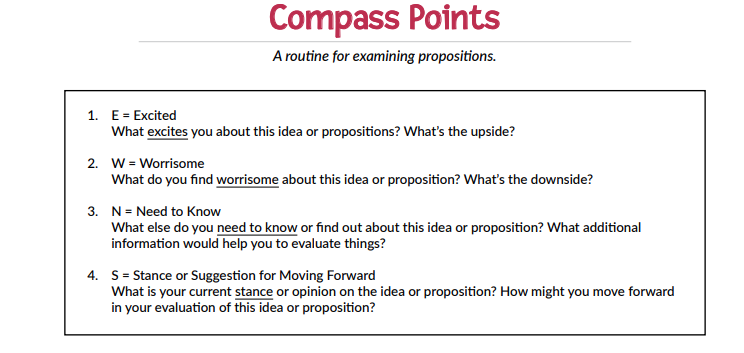
Credit-https://pz.harvard.edu/resources/compass-points

These methods enable IB classrooms to become hubs of inquiry where students are empowered to take charge of their education.

Creating an Environment for Inquiry

IB classrooms are designed to be dynamic spaces where students are active participants of knowledge rather than just passive recipients. In an inquiry-driven classroom, the learning environment speaks for itself—even in the absence of teachers and students. The arrangement of furniture shapes interactions, while wall displays reflect what is valued.

Educators must be intentional about the messages their space conveys and how it supports learning, ensuring it nurtures student growth and deeper understanding.

Key features of IB classrooms include:

  • Multiple Learning Centers: Areas dedicated to exploration—science labs, writing corners, problem-solving hubs—encourage independent discovery.
  • Real-World Applications: Learning is connected to real-life scenarios, making knowledge practical and meaningful.
  • Collaborative Knowledge Construction: Discussions, debates, and peer interactions enhance understanding.
  • Flexible Curriculum Pathways: While structured, the IB curriculum allows students to explore their interests, keeping learning relevant.

This environment transforms students into engaged learners who approach problems with curiosity and confidence.

Student-Led Discussions & Peer Learning

IB classrooms thrive on student-led discussions, shifting the focus from teacher-driven instruction to collaborative learning. This approach:

  • Develops critical thinking and the ability to construct and defend arguments
  • Enhances communication and confidence in expressing ideas
  • Encourages peer learning, where students gain diverse perspectives
  • Strengthens higher-order questioning and analytical skills

Participating in debates and interactive discussions allows students to take ownership of their learning and refine their ability to think critically and articulate ideas.

IB Projects: Nurturing Inquiry Through Personal Project and Extended Essay

The IB Diploma Programme and MYP include unique components designed to deepen inquiry and develop well-rounded learners:

Personal Project (MYP): A student’s journey of passion and exploration, the Personal Project is the culmination of their MYP experience. Over the course of a year, students choose a topic of personal significance, set ambitious goals, and engage in independent research, problem-solving, and creativity. Whether it's designing a mobile app, composing music, or launching a community initiative, this project fosters self-management, critical thinking, and innovation, empowering students to take ownership of their learning.

Extended Essay (DP): A deep dive into academic inquiry, the Extended Essay challenges DP students to conduct independent research on a subject of their choice, crafting a 4,000-word investigation akin to university-level work. It hones their ability to formulate research questions, analyse sources, and construct well-reasoned arguments. More than just an academic requirement, the Extended Essay cultivates curiosity, resilience, and intellectual rigour—skills essential for lifelong learning and success beyond school.

The IB Advantage: A Future-Ready Approach

IB educators cultivate thinkers, innovators, and global citizens for the future. By fostering inquiry, critical thinking, and real-world engagement, the IB Diploma Programme equips students with:

  • Analytical Thinking: The ability to ask, evaluate, and synthesise information
  • Research Proficiency: Skills to investigate, analyse, and present findings
  • Adaptability & Creativity: Exposure to diverse ideas and problem-solving approaches
  • A Lifelong Passion for Learning: Curiosity-driven education that extends beyond school

At Shiv Nadar School, inquiry-driven learning is central to education. Through a rigorous yet dynamic IB curriculum, students cultivate curiosity, creativity, and critical thinking—preparing them not just for university but for life. By blending hands-on exploration, interdisciplinary connections, and student-led learning, we aim to transform learners into thinkers, innovators, and changemakers.

2025-03-27

Understanding IB Education: A Guide to Its Programmes and Offerings

The International Baccalaureate (IB) is a globally recognised educational framework designed to nurture critical thinkers, problem-solvers, and lifelong learners. Since its inception in 1968, IB has championed an approach to education that moves beyond rote memorisation, encouraging deep understanding, interdisciplinary connections, and real-world application.

Unlike traditional education systems, IB fosters independent thinking, research skills, and global awareness. It integrates a range of assessment methods, going beyond exams to evaluate a student’s analytical, creative, and problem-solving abilities. IB students graduate with a strong academic foundation, ethical values, and leadership skills that prepare them to thrive in university and beyond.

An Overview of IB Programmes

IB offers a continuum of education through three interconnected programmes:

  • Primary Years Programme (PYP) – For students aged 3 to 12, nurturing curiosity and foundational learning.
  • Middle Years Programme (MYP) – For students aged 11 to 16, bridging primary and secondary education with an inquiry-driven academic approach.
  • Diploma Programme (DP) – For students aged 16 to 19, a rigorous pre-university curriculum that develops critical thinking and global perspectives.

Each programme builds on the previous one, ensuring a seamless transition from early learning to higher education.

Why Choose IB?

The IB is widely respected for its holistic educational model, which fosters intellectual curiosity, global citizenship, and academic excellence. Some of its key benefits include:

  • Globally Recognised – Offered in over 160 countries worldwide, the IB is recognised by leading higher education institutions across the globe.
  • Interdisciplinary Learning – Encourages students to connect knowledge across subjects rather than studying them in isolation.
  • Lifelong Learning – Develops research, analytical, and problem-solving skills that prepare students for continuous learning.
  • Leadership Development – Through projects, community engagement, and teamwork, students cultivate creativity, collaboration, and responsibility.
  • Global Citizenship – Encourages cultural awareness, ethical decision-making, and a deeper understanding of global issues.

The IB Primary Years Programme (PYP)

The PYP is designed to spark curiosity, build confidence, and lay the foundation for a lifelong love of learning. It emphasises:

  • Student Agency – Learners take ownership of their education, making choices and asking questions that drive their learning.
  • Inquiry-Based Learning – The curriculum is built around six transdisciplinary themes that integrate science, mathematics, language, and social studies.
  • Holistic Development – A focus on intellectual, emotional, and social growth through real-world learning experiences.
  • Global Awareness – Students develop an understanding of diverse cultures, perspectives, and world issues.

By integrating real-world contexts into the classroom, the PYP nurtures critical thinking, problem-solving, and independent learning—qualities that prepare students to be engaged, responsible global citizens.

The IB Middle Years Programme (MYP)

The MYP builds upon the PYP’s foundation, introducing a more structured academic framework while retaining the emphasis on inquiry-based learning. Students study eight subject areas, including:

  • Language & Literature
  • Sciences
  • Arts
  • Mathematics
  • Individuals & Societies
  • Language Acquisition
  • Physical & Health Education
  • Design

Key features of the MYP include:

  • Project-Based Learning – The Personal Project allows students to explore a topic of interest, fostering research, time management, and presentation skills.
  • Interdisciplinary Approach – Subjects are interconnected, allowing students to apply their knowledge across different fields.
  • Global Contexts – The curriculum incorporates real-world challenges such as environmental sustainability, human rights, and cultural diversity.
  • Pathway to Higher Learning – The MYP prepares students for the IB Diploma Programme and other advanced academic pathways.

Through its unique blend of inquiry, academic depth, and real-world application, the MYP shapes students into independent thinkers and responsible global citizens.

The IB Diploma Programme (DP)

The DP is the final stage of the IB continuum. Recognised as one of the world’s most rigorous pre-university qualifications, it equips students with critical thinking skills and a strong sense of global responsibility.

The DP Curriculum

Students study six subject groups:

  • Language & Literature
  • Sciences
  • Individuals & Societies
  • Mathematics
  • The Arts
  • Language Acquisition

Beyond these subjects, DP students complete three core components that set IB apart:

  • Theory of Knowledge (TOK) – A deep exploration of knowledge, reasoning, and ways of thinking.
  • Extended Essay (EE) – A 4,000-word research paper, preparing students for university-level academic writing.
  • Creativity, Activity, Service (CAS) – A programme integrating artistic expression, physical activity, and community engagement to develop well-rounded individuals.

The IB Diploma Programme’s rigorous coursework, assessments, and emphasis on self-directed learning make its graduates highly sought after by top universities worldwide.

Education for the Future

The IB framework goes beyond just academics—it shapes students into inquisitive, ethical, and globally aware individuals. Whether in the PYP, MYP, or DP, IB students develop a strong sense of independence, social responsibility, and resilience—qualities essential for success in an ever-changing world.

At Shiv Nadar School, our adoption of the IB curriculum reflects our commitment to nurturing young minds who are ready to lead, innovate, and make a meaningful impact on the world.

2025-03-27

Subscribe to Blog